Your party has been tracking down the dragon across the wilderness. Traveling over the plains took a long time. The forest was full of minions who harassed and ambushed you. Now, mountains loom ahead as you near the location of the creature’s lair. Blocking your way is a deep gorge you need to cross and you are running short on time.
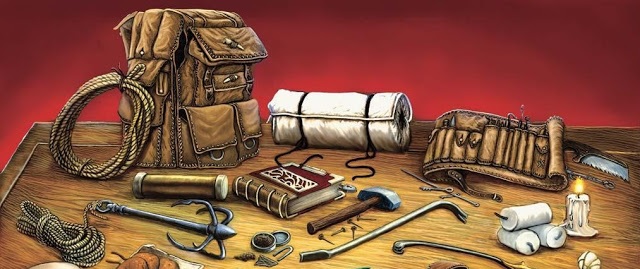
The wizard has assessed the distance and the fighter figures he can throw a grappling hook across the fissure so the thief can cross so you can make a rope bridge.
Confidently the fighter’s player states, “I secure a grappling hook on the end of my rope and throw it across into the branches of a tree on the other side.”
The game master responds, “Do you have a grappling hook written down on your character sheet?”
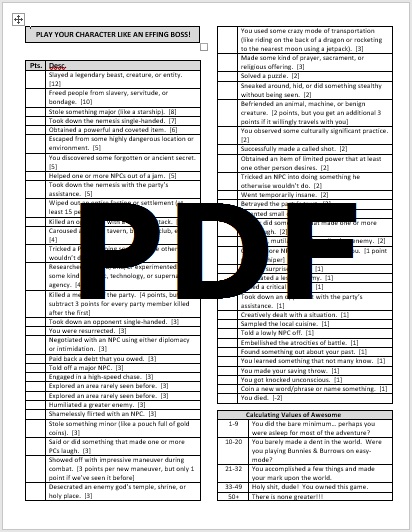
There are a lot of RPG players – way more than Game Masters. So, it was high-time that I wrote a little something for those on the other side of the screen. Recently, I came out with a short PDF called Play Your Character like a Fucking Boss. It’s a follow-up to the successful How to Game Master like a Fucking Boss.
In the spirit of playing a character like a fucking boss, what follows is a fun list of possible character actions, words, and accomplishments that can gauge your players’ raw quotient of awesome in a given session. For ease of play, download this sheet, print out a few copies, and then hand them to your players. During the session, players put a check-mark next to each entry that they’ve done, said or experienced. At the end of the night, total up the point values next to each item and see how they did. Continue reading “Play your character like an effing boss!”
It’s throwback-time, where we revisit an awesome article from years ago…
In my last article, Character Connection = Player Satisfaction, I talked about hooks that connect the character and the player to the campaign. One of the three fundamental questions I suggested readers to ask themselves was, “Why did my character choose his class?” The answer to that question helps connect your character to the setting. Connection to setting, along with connection to story and group, form the basic foundation for us to continually enjoy our characters. Of course, prior to coming up with an answer, you must have a fairly solid understanding of the setting in which the character is to be connected to.
With that in mind, here are a few ideas for class-based character backgrounds. These are by no means complete backgrounds but they do form a starting point upon which to build your character’s connection to class and setting. Continue reading “Class-Based Character Backgrounds [part 1]”
Olympus Inc., a modern day setting for Savage Worlds written by Gilbert Gallo and Charles White (produced by Fabled Environments), is a setting in which the world is controlled by shadow groups. These groups are very powerful, and exert their influence to further their own goals. Unlike most worldwide corporate conglomerates, however, this power does not simply come from significant wealth and connections. In Olympus Inc, the power comes from the deities of the Ancient Greek pantheon. Continue reading “Olympus, Inc. – Urban Fantasy with that cool Cyberpunk feel”
I’m currently engaged in my 10th Kickstarter campaign at the moment. It’s a project called Trinity of Awesome Returns!
A lot of people have asked me about what all goes into my Kickstarters; like, how do you get from the initial idea (step A) all the way to fulfillment (step Z)? Well, as you can imagine from the space between the first and last letters of the alphabet, there’s a lot that goes into it. This article will focus on the beginning of the process. Step A, if you will. Continue reading “Part of my Kickstarter Process”
Shadowrun: Anarchy is the new, rules-light, narrative-focused, alternate ruleset for the world of Shadowrun (You can read my review Here). It allows GMs and players to get into the action and intrigue of Shadowrun much faster and to stay there much longer without reference to rules and charts and extensive calculations of Shadowrun 5th Ed.
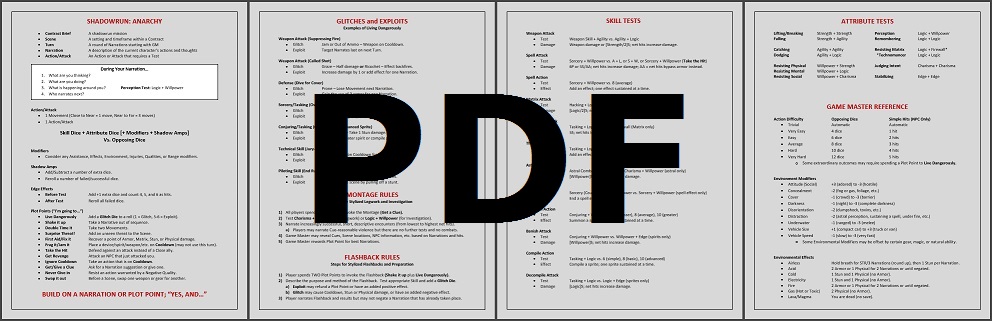
There are rules, however light, and every game with rules deserves a GM Screen. Players unused to narrative-heavy roleplaying may also need a little more on which to cling while they get their sea legs. Shadowrun: Anarchy, the book, also leaves a lot up in the air regarding some rather simple mechanics. For all of these reasons, I created a Narrative Aid for myself and my players to help us navigate the alternate ruleset and the meta-game that plays on top of it.
Attached is a 4-page document (fan material) that is intended to be printed 2 Pages per Sheet and Print on Both Sides (flip pages on short edge). It could easily be printed on 4 pages to create the quintessential quad-fold GM screen. Below are details that I chose to include or add: Continue reading “GM Screen / Narrative Aid for Shadowrun: Anarchy”
In a recent review of CGL’s new Shadowrun: Anarchy, I pointed out that the cast of NPCs published therein were best used as inspiration for your own cast of NPC threats. There were issues with balance, utility, and playability that needed to be resolved before I pit them against my players.
In this article, I submit to you the set of NPCs that I have been using. I have made several changes to fit my gaming table and they may inspire you as well. Here are the changes I have made:
Reformatted each entry to list dice pools rather than Skill + Attribute (unless variable). So if it says 8, roll 8.
Standardized most Shadow Amp phrasing.
Renamed Vehicle Weapons to Gunnery (for space and clarity); and Piloting (Ground) or Piloting (Other) to Pilot Ground and Pilot Other (that way you can add a specialization without double parenthesis).
Used kla060365’s (from Shadowgrid Forums) re-balance of Assault Rifle and Machine Gun. Applies a -2 to ARs and MGs at close range (this gives purpose to SMGs).
Stratification
Similar to Professional Ratings, I needed a way to measure the threat level each NPC would pose. These are somewhat loose levels based on Attributes + Skills + Shadow Amps.
Threat Levels are Thug Level (<28), Gang Level (28), Street Runner (38), Prime Runner (48), Terror Level (>48).
Added options for Mooks who use only one Condition Monitor (like SR5 Grunts), and Mains who gain one Positive Quality.
Categorization
Separated NPCs into Categories such as: Critters, Corporate, Magic (includes Spirits), Matrix, Military, Security, Shadow (includes generic runner archetypes), and Street. This might determine which Knowledge Skills or types of Contacts might apply.
Each category has about 4 entries.
Expanded Entries
Added Barghest, Boston Lockdown Head Cases (Shambler, Rager, Manipulator, Hidden), Corporate Security (Elite), Enemy Drone (Mini), Enemy Shaman, Enemy Technomancer, Rent-a-Cop (HTR), two vehicles (Armored Personnel Carrier and Light-Assault Copter), five generic runners (Company Man, Street Sam, Pistol Adept, Razor, Combat Medic), and Wiz-Ganger.
Added options for Enemy Mages, Lesser Spirits, Blood Spirits, Toxic Spirits, Shadow Spirits, Intrusion Countermeasures, Sprites (a new version), Ganger types (because not all gangers replace their arms…), and Gun Emplacements.
Re-Balanced Entries
Tried to get each entry closer to an appropriate Threat Level by adding/subtracting Attributes, Skills, or Shadow Amps. Probably just gamer OCD.
Rebuilt Spirits with a few non-combat options (that can be taken in lieu of combat options). This will help for those tables that tend to shy from combat-heavy campaigns.
Rebuilt Sprites to closer match IC mechanics and power levels. I added Firewall for proper Matrix use. I removed Willpower and Charisma and added the Tasking skill to use Complex Forms.
Rebuilt Enemy Drones. Drones are vehicles with Armor only (no Condition Monitor, like it outlines in the book). They use Logic to make attacks rather than Agility, so that drone size has less to do with accuracy. I defined Flying as a Shadow Amp that forces a reroll when attacked but takes extra damage when hit. Audio Analyzer just interprets voice commands.
Re-balanced Enemy Drones weapon options. Small Drones can no longer take out an entire team of Prime Runners with crazy accurate grenade launchers and death from an unhittable killing platform.
I hope that you find this list of Anarchy Threats useful in challenging your players (without boring them or murdering them). They may inspire you to create interesting Contract Briefs and even your own NPCs suitable for your own table.
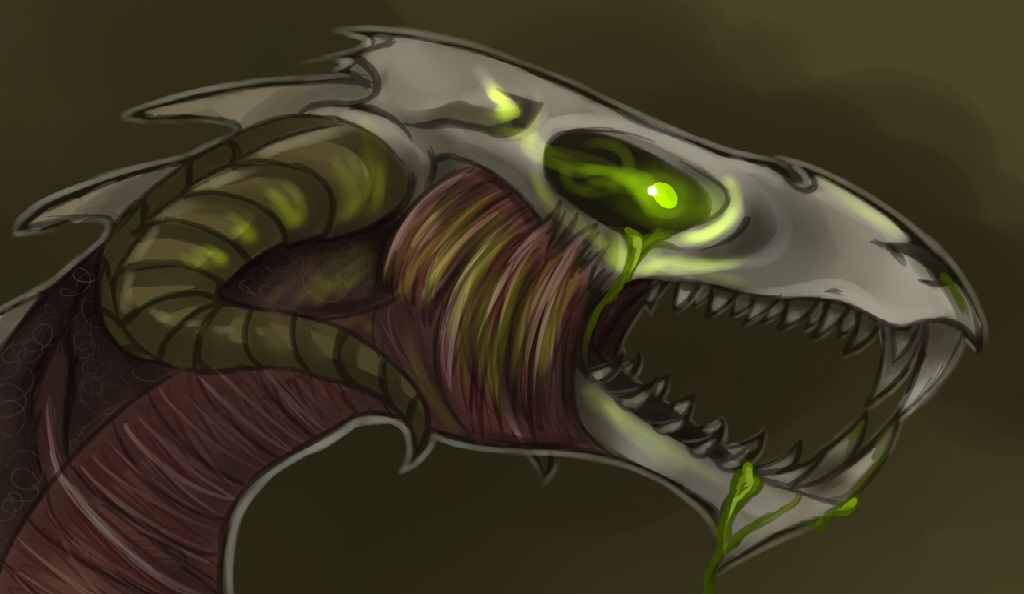
Liches are common threats found in many types of RPG games. Unfortunately, it’s far too easy for the GM to roleplay them in a simplistic manner, as simple monsters to vanquish, giving them no backstory or interest, and an opportunity for world building is lost. But by making them unique, giving them unfamiliar and difficult to destroy phylacteries, giving them unique places to find them, giving them individual motivations and (fill in the blank) they can truly become the threats they should be. Continue reading “Making Undead Scarier, Part 4: The Lich!”
It’s throwback-time, where we revisit an awesome article from years ago…
I don’t think I’m being overly presumptuous when I say that most, if not all gamers want to play a great character. I’m not necessarily talking about playing some super powerful, mega bad-ass; I’m talking about a character that is something more than just a collection of stats and abilities running around doing stuff. I’m referring to a character brought to life for everyone at the table in some unique, interesting, and memorable ways and whose individual story enhances the unfolding group story. Great because the character inspires and challenges us to become better roleplayers, while simultaneously remaining exciting and fulfilling for the individual player throughout the campaign. We want to play a character that truly has Character. Continue reading “Character Connection = Player Satisfaction”